On April 19, 1995, the United States witnessed the worst single act of terrorism in its history. Just after 09:00 in the morning, a massive explosion ripped apart the Alfred P. Murrah Federal Building in Oklahoma City. This killed 168 people and injured 680. The building was left a hollow shell as if some gigantic hand had gouged out most of the structure. The two perpetrators were Timothy McVeigh and Terry Nichols whose names would become notorious in the months that followed.
The bombing happened on the second anniversary of the Waco Siege – a shoot out between law enforcement and members of the Branch Davidian religious cult. I’ve blogged about this elsewhere on this site in some detail. This had become a totemic incident for the extreme Right in America, depicted as an over-powerful federal government snuffing out civil liberties and taking lives with impunity. The hysterical explanation to Waco doesn’t match up to any serious analysis. But it created a burning anger among some, like McVeigh, on the violent extreme-Right.
I was working as a journalist at Sky News in London in 1995 when the Oklahoma bombing happened. It was an early test of rolling news as the newsroom threw up live links and interviews for hours on end. All other news was quite rightly shoved to one side. This was an appalling incident that had claimed the lives of men, women and children. It was senseless and on a dreadful scale.
Why did the Oklahoma bombing happen?
McVeigh was a veteran of the first Gulf War in the Middle East who then became radicalised into anti-government conspiracy theories – especially around the Waco Siege. His views were a familiar mix of libertarian gripes about taxation, gun ownership, federal agencies, and the perceived erosion of civil liberties. But this was turbo-charged by Waco and other incidents leading to an ideological view that the federal government was bent on tyranny.
McVeigh even managed to factor Area 51 into this justification for action. As with other extreme-Right terrorists, he declared himself a guardian of the American Constitution. He was convinced of the need for direct action, initially toying with the idea of assassinating high-level figures in President Bill Clinton’s administration. He even shared these musings with friends. At some point however, McVeigh decided against killing an individual and instead, drew on his knowledge of explosives to take down a large federal building.
The explosion itself was certain a dramatic statement – one that killed nineteen children in a day centre located within the building. McVeigh later stated he “thought it was terrible that there were children in the building”, but didn’t express much by way of remorse.
McVeigh was arrested shortly afterwards on Interstate 35 because his vehicle had no license plate. He was also in possession of an illegal firearm. His T-shirt had an image of President Abraham Lincoln with the slogan in Latin: sic semper tyrannis. These were the words that John Wilkes Booth allegedly shouted at Ford’s Theatre, Washington DC in 1865 after assassinating Lincoln. On the back was an image of Thomas Jefferson and a quote about the tree of liberty needing to be nourished with the blood of patriots and tyrants. Doubtful that Jefferson had in mind what McVeigh had committed that day.

Radio shock jocks to blame?
Today, our concern is about the influence of social media figures to promote extremism and division. In the mid-1990s, President Clinton took aim at conservative radio shock jocks who he claimed had fuelled hatred and created a political climate in which McVeigh felt justified to carry out the Oklahoma bombing.
Must be said that the media environment at the time looks very tame compared to the free-for-all of social media in our time. From the late 1980s, Rush Limbaugh pioneered the shouty and brash style of radio broadcasting that would irk Clinton. Limbaugh mixed prairie populism with self-proclaimed common sense and denigration of opponents as “environment wackos”, “femi-Nazis”, and “commie libs”. He introduced the idea of a liberal presidency, like that of Bill Clinton, being in some way an illegitimate takeover of power – which left the question: should a liberal president be overthrown?
Other shock jocks who became wildly popular in the mid-90s included Bob Grant, Oliver North and G. Gordon Liddy. Quite a line-up! Grant had been broadcasting since the 1940s and was an explicit racist. Oliver North was an ex-marine swept up in the Iran-Contra scandal under President Reagan in the 1980s while G. Gordon Liddy was one of the Watergate burglars under President Nixon in the 1970s. None of these shock jocks was to blame for the Oklahoma Bombing but the accusation was that they influenced impressionable young men like McVeigh who were developing an extremist outlook.
On the other side of the political spectrum, there were liberal voices in the letters columns of the newspapers who expressed views that came worryingly close to schadenfreude over the bombing. Their argument being that the United States had inflicted death and injury on men, women, and children in foreign conflict zones and was now receiving a taste of its own medicine. This was an ill-judged bit of ‘whataboutery’ when mothers in Oklahoma were grieving for their lost children.
Terrorism on the retreat?
Compared to the heady days of the 1970s, it seemed as if global terrorism was on the retreat in the years leading up to Oklahoma. But this was far from the truth. Terrorism was changing: the people involved; the objectives; the methods. The World Trade Center bombing of 1993 by Al Qaeda should have been a sufficient warning and of course, AQ would return in 2001 to bring both towers crashing to the ground. Terrorism very definitely had not gone away.
The mistake some made was in assuming that after the collapse of the Soviet Union and the overwhelmingly dominant position the United States assumed on the world stage at the start of the 1990s, that ideological divisions were somehow wiped out. Yes, communism was in steep decline as a motivator for violence. But other ideologies were in the ascendant – especially violent forms of Islamism and extreme-Right ethno-nationalism, or white supremacism.
After several years as a journalist, I went on to work as a communications consultant in countering violent extremism (P/CVE) and by the 2010s, nobody doubted that the twin threat of violent Islamism represented by ISIS, AQ, and others – and the threat from white supremacists, posed by a myriad of groups – was very real. Oklahoma was the first major salvo of resurgent, organised racism in the United States. The bombing eclipsed any single act by the Ku Klux Klan.

Execution of McVeigh over the Oklahoma bombing
In June 2001, McVeigh faced his own execution. Ironically, this was just three months before an even worse atrocity against the World Trade Center in New York – the horror of 9/11. McVeigh’s lawyers fought to delay his death sentence for multiple murder while the killer demanded that his execution be televised. Unbelievably, the Entertainment Network sued for the right to webcast McVeigh receiving his lethal injection. A federal judge threw out the case.
After 1999, he was held at the United States Penitentiary Terre Haute in Indiana where his lethal injection would be carried out. In the lead up to his death, the Vegan campaigning organisation PETA wrote to McVeigh asking him to reject meat in his final meals. Apparently, he wrote back suggesting they try their luck with the Unabomber, Ted Kaczynski, whose prison address he could forward to them.
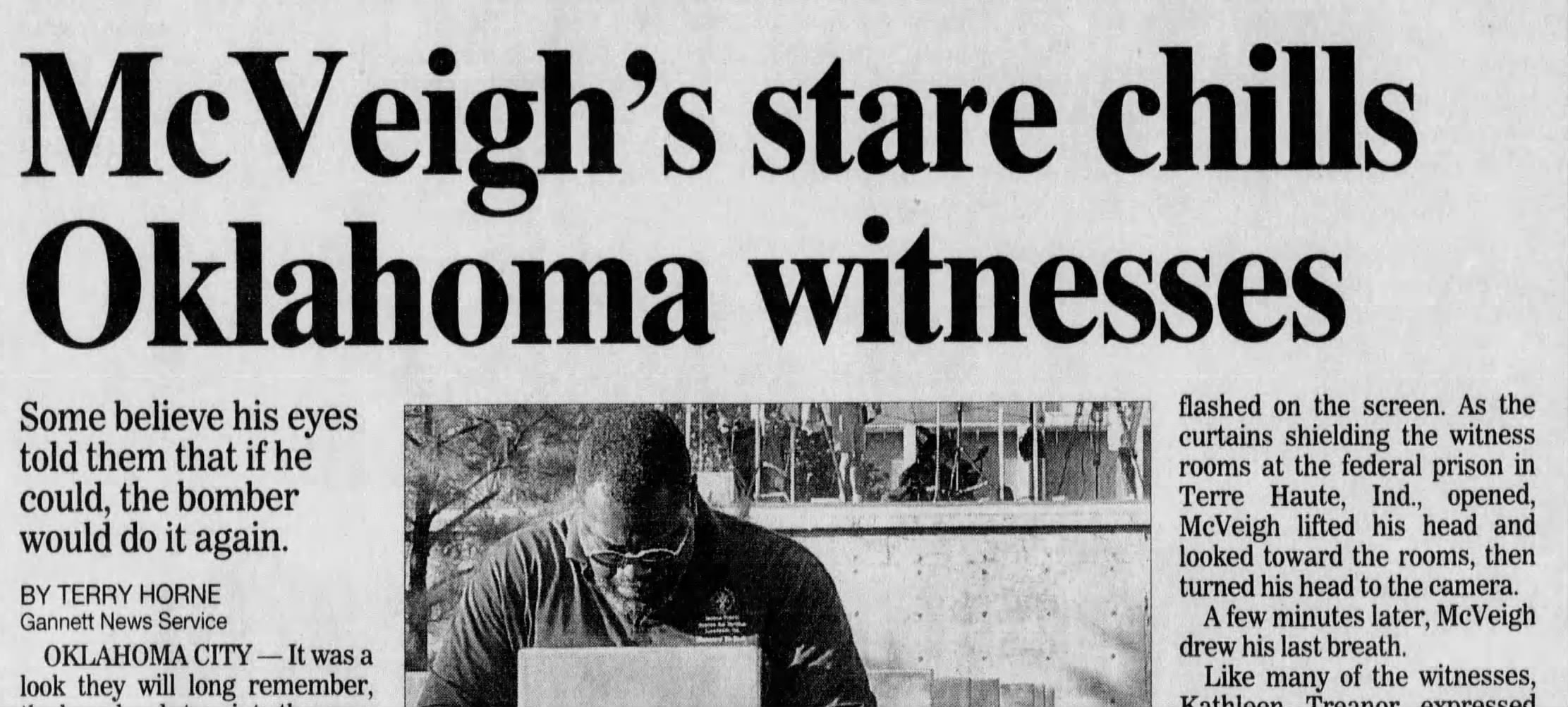
On the day of his execution in June 2001, protestors were divided outside the prison between those celebrating the death penalty and those opposed to this form of punishment. McVeigh was strapped into the gurney at 7am on June 11 and there was a delay of several minutes while prison officials attempted to get a video link with Oklahoma City for the green light to begin.
At 07:10, sodium pentothal was injected into his leg sending McVeigh to sleep – though his eyes remained open. This was followed by Pancuronium Bromide, a muscle relaxant that prevented him breathing. And finally, potassium chloride that stopped his heart. With that, the Oklahoma bomber was dead.