In the early 1980s, I studied and worked in Liverpool at a time when there was stratospheric levels of unemployment, dire poverty, and faced with no prospects – men and women turned to sex work. In the Toxteth district, it was a daily fact of life to see women on the streets in both daylight and at night. What is shocking looking back are the widespread attitudes on the issue of prostitution. Even when one sex worker was brutally murdered on Christmas Eve, 1983.
The Green Door Murder – 1983
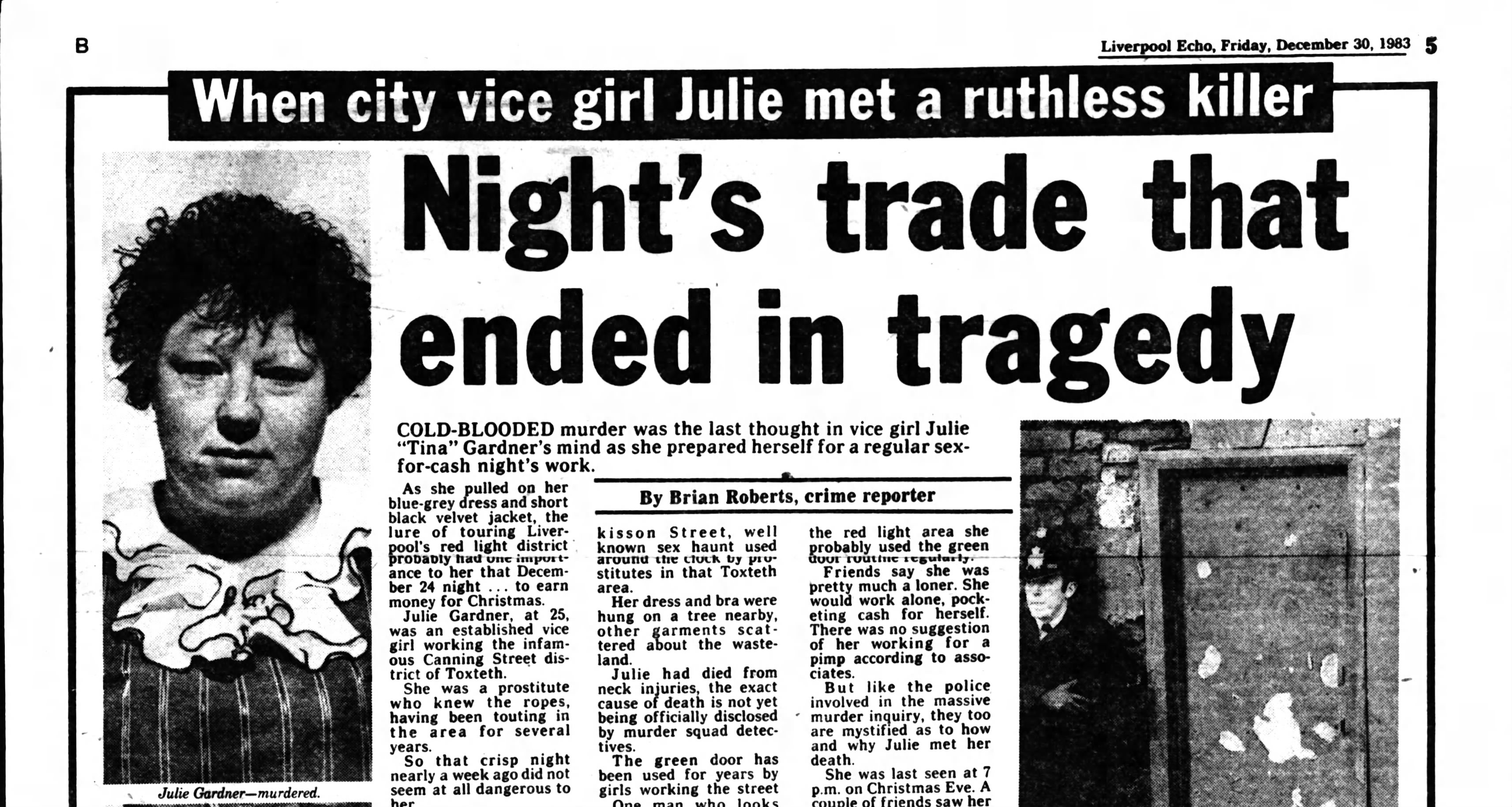
Julie Gardner, also known as Tina, was working on the streets to earn money for Christmas. For anybody living on the poverty line in those days. Christmas was a time to dread. Children expecting presents. Families hoping for a slap up turkey dinner. And all the hidden expenses that arise. Julie had been a sex worker for several years and knew how to handle herself – coping with abusive men, drunks, and so on.
Yet at noon on Christmas Day, two school pupils chanced upon her naked body slumped behind a green door on brick-strewn land near Huskisson Street – in the heart of Toxteth. The crime was referred to as the Green Door Murder. All over Liverpool, there were desolate patches of land where streets of Victorian and Georgian houses had once stood but had succumbed either to the Luftwaffe in World War Two or redevelopment in the post-war era. Bleak tower blocks had sprouted up among the ruins of old, working-class neighbourhoods.
The Liverpool Echo reported the murder, referring to Julie as a “vice girl”. The truth was that Julie was a mother of three young children with a family who loved her very much. Her father, a 58-year-old unemployed joiner, had to identify his daughter’s body before returning home to give her children as good a Christmas as possible. He told them that “mummy won’t be coming to see them anymore”.
The student newspaper at Liverpool University, where I was an undergraduate in December 1983, wrote a full-page article that took a sympathetic stance though I’m not convinced the analysis would stand up to scrutiny today. The female journalist in question opined: “Prostitutes do act as a palliative for men’s burning sexual needs and frustrations, which would otherwise be left unsatiated” (sic).
Nearly a year later, a 41-year-old man pleaded guilty to manslaughter. In his defence, he claimed that Julie had insulted his sexual ability and referred to another sex worker, with whom he’d lived for a while, as a “slag”. Provocation was a well-worn defence of provocation used to legitimise violence against sex workers and also gay men (“gay panic defense”) – as an excuse for killing them. The accused asserting that the red mist descended and they lost all control as their rage surged. It’s depressing how often this BS succeeded in courts around the world up until recent times (and still in some countries).
Described in court as a “gentle person”, Julie’s killer rained down several blows before strangling her. He received six years for manslaughter at Liverpool Crown Court.

Elizabeth O’Rourke case in 1985
By July 1985, I was working as an adult education tutor in Liverpool when another high-profile case hit the local paper – the killing of Elizabeth O’Rourke, a woman from the suburbs who came into town to engage in prostitution under the name Clare. The crime was committed very close to where Julie was slain. The Liverpool Echo referred to Elizabeth as a “red light girl” (she was 44-years-old) who “plied” her trade on “the square” – the area of Toxteth where sex workers tended to operate.
The police called on “kerb crawlers” to come forward to offer help. I remember in my first year living in Liverpool seeing notices all over Toxteth ordering kerb crawlers to stay away – and that they wouldn’t be tolerated. The local residents association took the lead – not the police – in trying to stop men driving at suspiciously slow speeds through the area.
But while the residents were furious at the kerb crawlers, there was no kindness on offer for the sex workers. A spokesperson for the Canning Street residents spoke to the Liverpool echo after Elizabeth’s murder but didn’t want to be named. She accused sex workers of being on the streets from 10am “right through to 2am” and it was all very distressing for the “old people who have to put up with seeing and hearing what is going on”. They wanted prostitution stamped out along with the practitioners and their clients.
As for the police, when women involved in prostitution complained to the cops about being beaten up – they were told it was their own fault.
The 1980s had begun with the Yorkshire Ripper serial killer murders leading to the arrest and imprisonment of Peter Sutcliffe in 1981. The police had been lambasted for their handling of the case – and that included their appalling attitude towards the victims. But by the middle of the decade, you’d be hard pressed to say any lessons had been learned.
Elizabeth’s murderer was apprehended and received a life sentence in 1986 after claiming he had “freaked out” and committed the crime.