


The Algerian female boxer Imane Khelif provoked howls of outrage when she won her boxing bout in under a minute at the Paris Olympics 2024 – with unfounded accusations that she wasn’t a biological woman. Once again, the whole issue of transgender athletes has divided opinion and created a social media storm. But this is nothing new. Women athletes have long endured questions over their gender and identity going right back to the 1970s and beyond. Let’s take a look at the grim history.
Soviets accused of ‘beefing up’ their women athletes
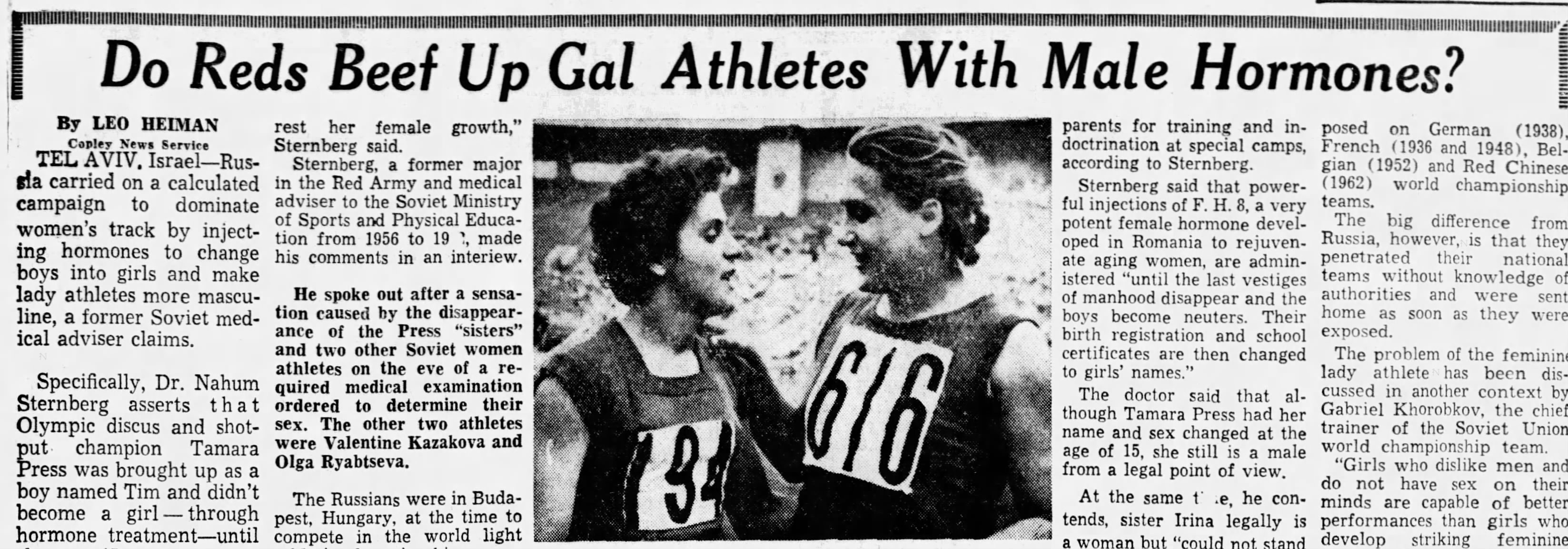
In my archives, I found a newspaper report from as early as 1966 claiming that the Soviet Union was injecting their female athletes with male hormones – and turning boys into girls. American newspapers quoted a doctor – reported to be a former Soviet medical adviser – claiming that the Russian discus and shot-put champion Tamara Press (1937-2021) was brought up as a boy called Tim until the age of thirteen. That was challenged as Tamara was recorded in World War Two evacuation records, at the age of five in 1942, as a female.
However, accusations persisted into the 1970s that the Soviets were injecting male hormones into prominent female athletes. The ‘eastern bloc’ European countries in the Soviet orbit – East Germany, Romania, Bulgaria, etc – were also said to be using hormones to alter the performance of competing women in different sports. At the 1976 Montreal Olympics, a western reporter asked the East German swimming team coach why his female athletes had broad shoulders and deep voices, to which he replied: “We brought them here to swim, not to sing.”
Tests carried out on women athletes
In September 1966, before the European Track and Field Championships in Budapest, 234 women athletes were asked to parade naked in front of three female gynecologists to prove they were female. This rather humiliating exercise was authorised by the International Amateur Athletic Federation. Years later in 1979, a newspaper report (pictured below) headlined “Proving You’re a Woman” looked back on this curious exercise.
The authorities in 1966 still remembered Zdena Koubková (1913-1986), a Czech athlete who won two medals at the 1934 Women’s World Games, who was brought up as a woman but subsequently diagnosed as intersex. After 1935, the athlete decided to transition to live as a man and had genital surgery, changing his name to Zdeněk Koubek.

Women performing ‘just like men’
With the growth of the feminist movement in the 1970s, it became increasingly unacceptable to undermine women athletes because they performed ‘just like men’. Introducing the sex test became yet another barrier that women had to negotiate to get the top of the sports world – with all the discrimination they faced on their career journey. Plus many were adolescents, still working out their identity and this imposed huge psychological pressure on often very vulnerable individuals.
Interestingly now, proving the gender of a female athlete has become a cause for certain prominent feminists. But in the 1970s, it was often viewed by feminist campaigners as a way to demean women in their achievements. The inference being that a woman couldn’t possibly excel in a particular sport unless they were a closet male. And even back in 1979, in the article above, it was pointed out that sex is more of a continuum than a sharp binary with some men producing as much female hormones as women and vice versa.


Hello,
I am researching tamara press and wondering if you have the full page to the newpaper image above or any additionalinfor on the quote: American newspapers quoted a doctor – reported to be a former Soviet medical adviser – claiming that the Russian discus and shot-put champion Tamara Press (1937-2021) was brought up as a boy called Tim until the age of thirteen. ?