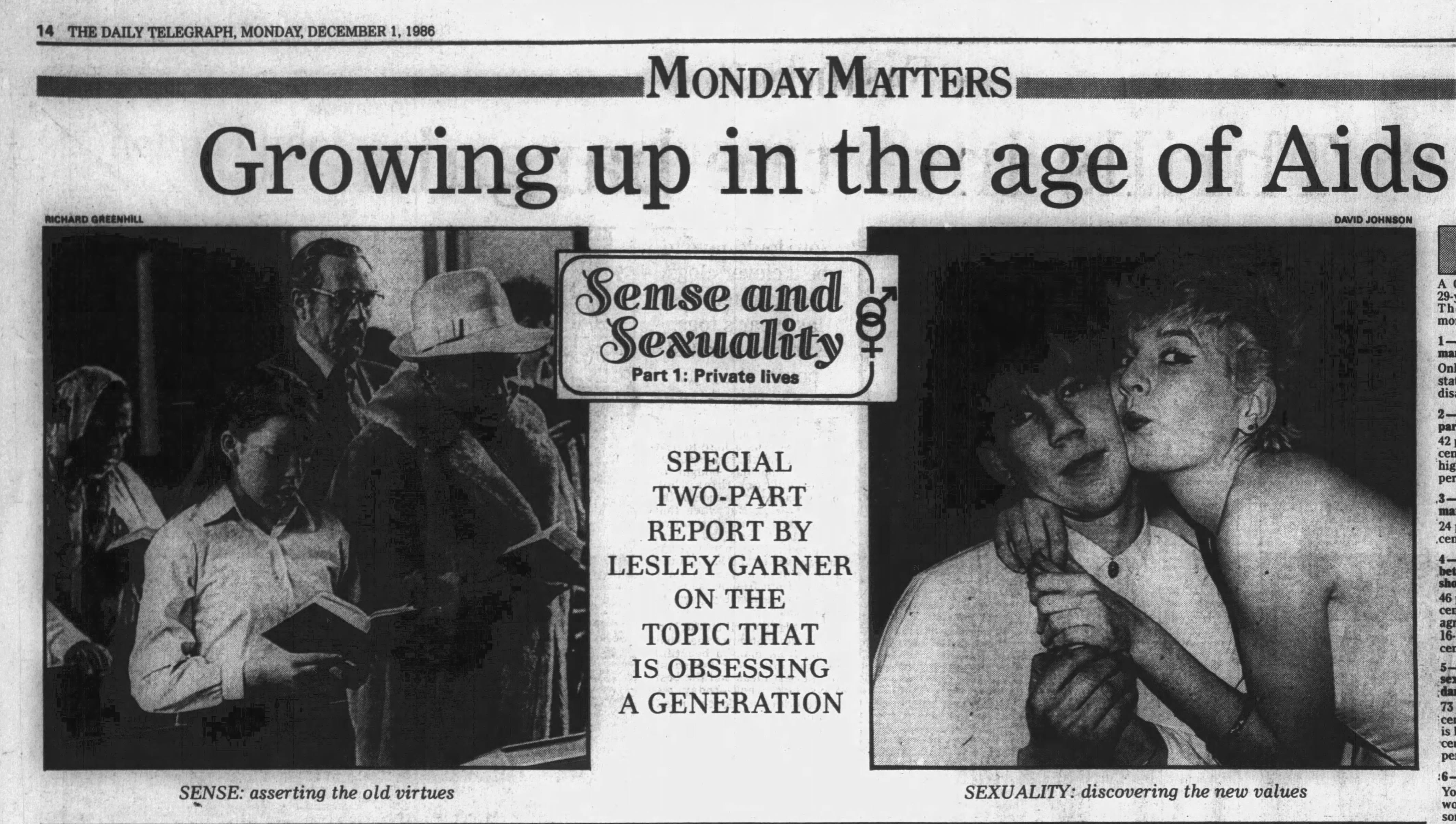
Attitudes to sex in the 1980s were more liberal than is sometimes assumed. But the decade was very different from the liberated 1960s and rebellious 1970s. The AIDS pandemic and rise of political conservatism impacted how young people viewed sex. Despite a climate of fear and repression, a survey in 1986 had very surprising results.
The Daily Telegraph newspaper commissioned Gallup, in late 1986, to ask 16 to 29-year-olds about their attitudes to sex. I was 23 years old in that year – so remember it well. There was a sense that while London – and big cities like Liverpool and Manchester – was a great place to be young, and express yourself, the rest of the country was still clambering out of the 1950s. Yet if this survey was truly an expression of national views among youth, it’s very forward looking.
And it’s a great snapshot of what young Boomers and Gen-Xers thought was acceptable in the bedroom. One thing to note is signs that the Gen-Xers were becoming more conservative than Boomers. One female teenager interviewed by the Telegraph explained that at parties, young people were shying away from immediate sexual contact, even if they fancied somebody, and expected to question that person about their previous sex life.
“In the past, I might have looked at someone at a party and thought, ‘He’s good looking, he looks fun’, but that’s just why you wouldn’t sleep with them now. And forget anyone with an American accent.”
“Sex is never right before marriage”. Only 11% of those polled agreed with this statement, compared to 71% disagreeing. During the AIDS pandemic, the so-called ‘moral majority’ called for total abstinence before marriage as way to tackle the spread of HIV/AIDS. Most young people were not interested in a return to Victorian morals.
“Sex with more than three partners is morally wrong.” Well, here’s where things get more confusing. 42% agreed while 35% disagreed. But among the under-21s, the level of agreement rose to 53%. So, a more conservative attitude among Gen-Xers.
“Sex is never right outside marriage”. 24% agreed while 60% disagreed. Back in 1981, we were force fed the “fairy tale” marriage between Prince Charles and Lady Diana. By the mid-80s, that myth was in tatters. Where the royals led, the British population followed. Infidelity was now all the rage.
“Homosexual relations between consenting adults should be allowed.” 46% agreed while 32% disagreed. I’m actually surprising that the percentage agreeing was that high. But then the shock within the breakdown of that figure. Agreement declined among younger people from 50% among 25-29 year olds, down to 49% among 21-24 year olds, and finally, 42% among 16-20 year olds. The impact of AIDS reporting in the media – especially virulently homophobic tone of the tabloid press – was changing attitudes – and not in a good way.
FIND OUT MORE: Grim times for LGBT people in the 1980s
“Having more than one sexual partner at any time is dangerous”. A whopping 73% agreed while only a promiscuous 13% disagreed. But that disagreement was higher among men at 18%, compared to women at 9%. Aside from concerns about AIDS, there was also a realisation that while men were ‘liberated’ in the 1960s to have more sex, women were not feeling empowered. There was also sky high rates of venereal disease with increasing awareness of the cancer-related risks posed by herpes, for example.
Nearly half of those surveyed were worried about contracting HIV/AIDS but women were slightly more worried about cervical cancer. Only 14% viewed AIDS as a moral question with 47% saying it was a health issue. Though nearly a third, 32%, thought it was “a bit of both”. Young people in the south of England were more likely to reject the idea that HIV/AIDS was down to morality.
“God’s punishment for sinners”. This claim about AIDS was rejected overwhelmingly by 81% disagreeing and only 9% agreeing. The influence of Christian churches was clearly in decline by the 1980s.
FIND OUT MORE: What young people were thinking in 1981
Depressingly, sexual behaviours were not that affected by the AIDS pandemic. Only 12% had changed their approach to sex with a mere 11% thinking more about contraception. Men were more likely than women to have altered their behaviour. This wasn’t helped by media commentary portraying AIDS as a gay issue, despite the global evidence that women were just as much at risk. Two thirds of those surveyed hadn’t changed their attitude to homosexuality as a result of AIDS but where they had, the change was invariably negative.
Attitudes to sex changed dramatically in the 1980s. Over the previous two decades, the emphasis had been on ‘liberation’ of women, gay people, and shaking off sexual repression. Promiscuity was almost a political statement. Men, in particular, would boast of the number of their (alleged) sexual conquests. Rock stars talked openly about their wild and unrestrained sex lives – and were viewed with admiration by teenage boys.
The 1980s threw a bucket of cold water over all that.