With Iran back in the news, it’s an opportune moment to ask how did this country come to be ruled by a theocratic caste combined with a parliamentary democracy? Up until 1979, Iran was under the thumb of a monarch – the Shah – who was pro-western and effectively policed the Middle East on behalf of the United States. After he was overthrown, the situation couldn’t be much different!
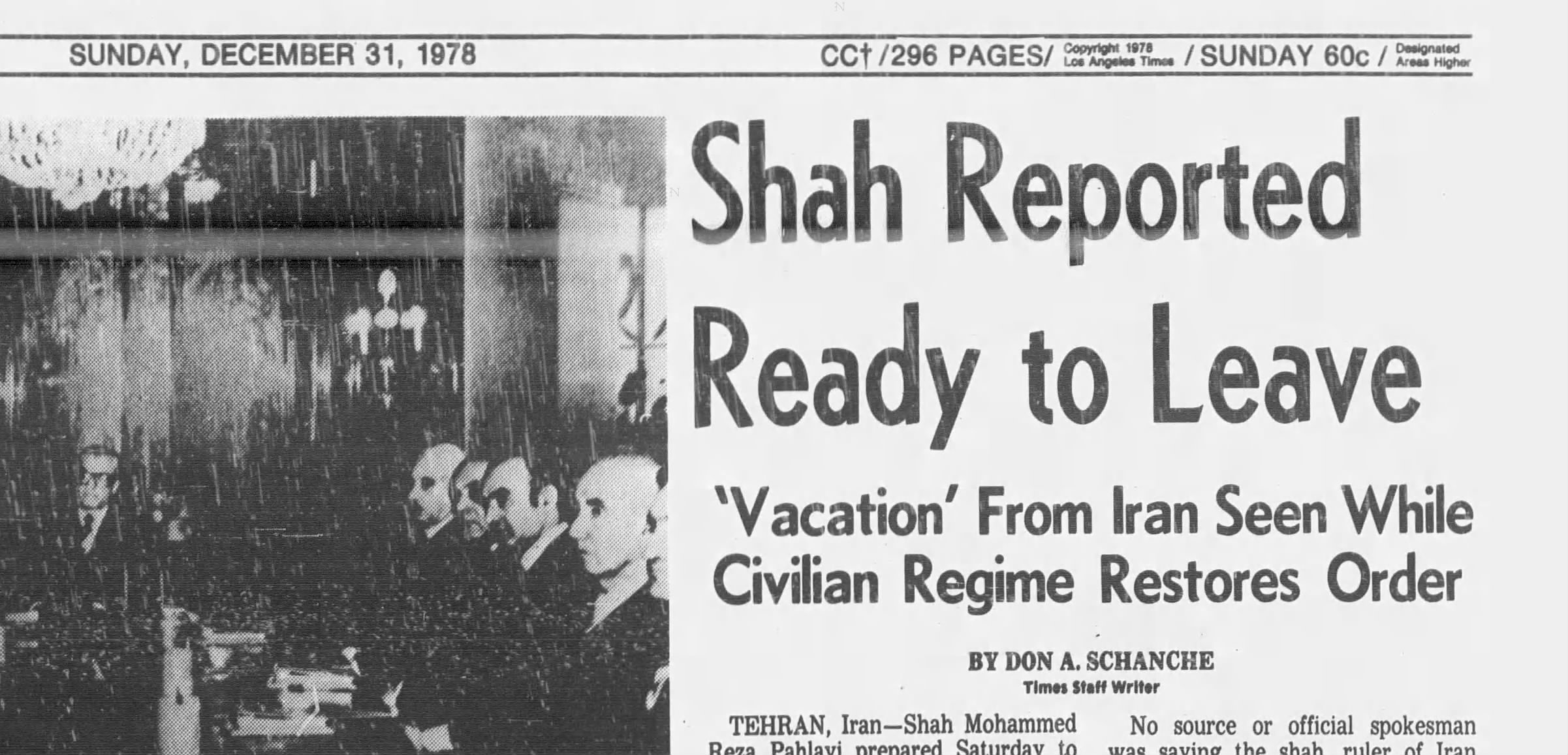
In January 1979, the Shah boarded a Boeing 727 at an airport in Teheran, the capital of Iran, and left the country he had ruled, forever. Two officers of the royal guard knelt to kiss his feet but he motioned them to stand. Even for Shah Mohammad Reza Pahlavi, there was a realisation that those days were over. Piloting the plane himself, the absolute ruler flew to Egypt and then on to the United States.
FIND OUT MORE: Iran and how the Left reacted in 1979
Having ruled Iran for 37 years, he assured everybody this was just a “holiday”, but few believed him. After decades with absolute power, he despised all ideologies: communism, Arab nationalism, and Islamism. It was the latter that would prove to be his undoing. A revolution burst to the surface that was initially led by the socialist Left but effectively hijacked by the Islamist Right under the exiled Ayatollah Khomeini.
The shah was a mass of contradictions. He had embarked on a programme of modernisation in Iran while retaining all the trappings of royal power. Terrified by the threat posed to him by communism, nationalism, and Islamism, he used a secret police force – the SAVAK – to sniff out and stamp out dissent. He oversaw increasing urbanisation but this created a new city-based working class that disliked his form of government. Meanwhile the so-called ‘bazaar’ class of traditional merchants disliked the shah’s modernising and were open to the conservative, religious messaging of Ayatollah Khomeini.
Some commentators believed the Shah was open to creating a constitutional monarchy with a parliament able to genuinely legislate freely. But circumstances moved rapidly against him. This was one of those situations where neither reform nor repression were going to reverse the inevitable. By 1979, there was nothing the shah could do to prevent his own doom.
Shortly before his downfall, the Shah was asked by a journalist what had been his biggest error. He replied in a leaden voice: “To have been born.” As his regime fell, the tremors were felt all over the world. Throughout the Middle East, other monarchs wondered if they might face the same fate. The United States was appalled as it lost a valued ally. Israel, which had received 60% of its oil from Iran under the Shah, was shaken. Even the Soviet Union – with its large Muslim minority population – wondered if the ideology of Islamism might create problems within the USSR. Apartheid South Africa, which got 90% of its oil from Iran, found all supplies suddenly cut off.

In 1980, the Shah died of cancer in Egypt. He had been suffering the disease for some time. The funeral was attended by President Sadat of Egypt, who would be assassinated over a year later, and the former King of Greece, Constantine, another monarch who would never regain his crown.
Shortly before his death, the Shah accused two American oil companies of plotting his overthrow to boost energy prices. However, he declined to name the companies concerned and if the United States had, in any way, engineered his overthrow – they would soon come to regret it.