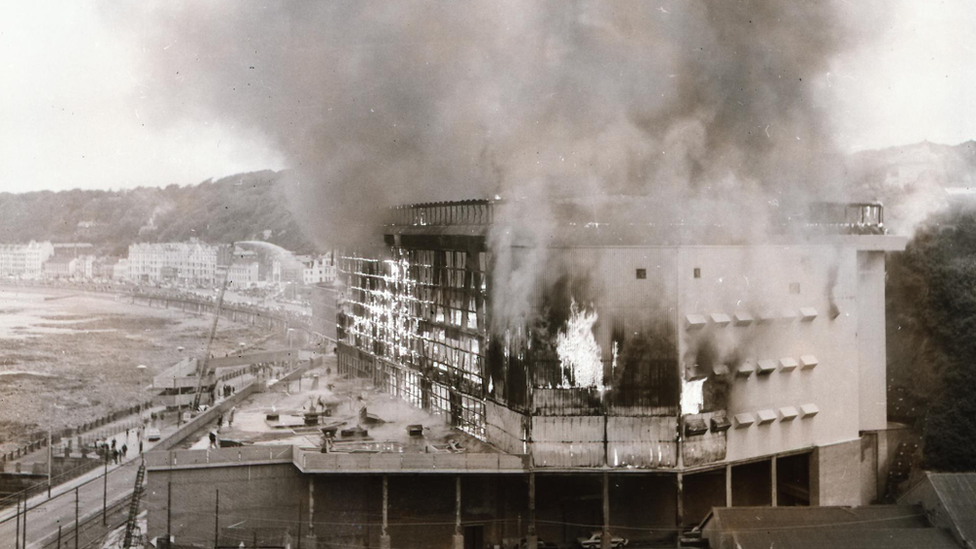
The 1970s was the decade that gave us the disaster movie, The Towering Inferno. The world’s tallest skyscraper catches fire and its height proves to be an insurmountable obstacle to rescuing the wealthy folk inside. This was a cautionary tale about the decade’s unshakable belief in modernity as well as the hubris and greed of its urban planners. A very British example of this was the building of Summerland at Douglas on the Isle of Man – and its subsequent destruction in a terrifying inferno.
I was at university in Liverpool in the early 1980s, a city located on the north-west coast of Britain where rainfall is plentiful and the wind can be biting cold. Since the 19th century, nearby Blackpool has been a major seaside resort with amusement arcades, donkey rides, and shabby bed and breakfast accommodation. If it couldn’t deliver sun, it could guarantee fun.
Not far away, another town looked on at Blackpool’s success and wanted a piece of the action. Off the coast, out in the middle of the Irish sea, is a self-governing bit of the United Kingdom called the Isle of Man with its administrative capital of Douglas. It wanted a share of Blackpool’s holiday business to attract visitors from cities like Liverpool.
In 1971, the Douglas Corporation spent £2 million building a vast indoor entertainment and leisure space to attract British holidaymakers. Summerland was a futuristic concept, typical of the 1970s, where visitors would be able to enjoy swimming, sunbathing, and games under a huge transparent plastic roof.
Summerland was built on to a cliff-face, which formed one of its walls, creating a very James Bond lair type effect. Managed by Trust House Forte, it promised tropical surroundings, summer shows, restaurants, bars, children’s playgrounds, crazy golf, bowls, cinema, disco, and most impressive was the indoor sunbathing area. After its first season in 1971, about 96% of visitors who were surveyed said they would return. Why go to Spain when Douglas could offer all the pleasures of southern Europe at a fraction of the price?
What could possibly go wrong?
Plenty as it turned out. Summerland was made of metal and plastic. A brochure promised that it would “set the architectural world alight” – prescient words indeed. The futuristic resort would fall victim to three Liverpool boys who decided to have a sneaky cigarette in a disused kiosk outside Summerland’s walls. Somehow, they set the kiosk on fire and then ran away.
DISCOVER: The 1981 New Cross fire
Incredibly, staff inside Summerland were not overly concerned. They believed the building was fireproof and no emergency action was required. But as the kiosk collapsed against the clear plastic windows, they were quickly disabused. Fire began to take hold. And yet, still, there no sense of impending danger. Visitors were still being admitted at the front entrance and initially, nobody bothered to contact the fire service.
The inferno spread at breakneck speed. Thousands of people were inside Summerland as the fire brought the huge plastic roof crashing down. A hundred local firefighters and fifteen engines pumped water from the sea in a vain attempt to put out the flames. While they struggled, a series of muffled explosions rocked the building.
Predictably, the emergency doors didn’t open and staff were clueless, having received little fire training. The evacuation of Summerland became a case of every man, woman, and child for themselves. As one eye witness stated: “I saw one man with his hair on fire and his coat melted off his back and running with a youngster in his arms.” The main entrance was clogged with hundreds trying to squeeze out. Those visitors in the sauna on the seventh floor were told to flee as a sheet of flame advanced towards them.
One newspaper carried an eery image of a man trapped behind an acrylic pane as he attempted to smash it. He did not survive. The tragic last moments of that victim pictured below.

In the days after the tragedy, police fanned out across Merseyside, which included the city of Liverpool, interviewing young boys aged between 10 and 16 as they sought the culprits who had accidentally started the inferno. Nobody would ever be prosecuted in connection with the Summerland disaster and the causes were put down to “human errors” and “poor communications”.

In the inquiry that followed, everybody was wise after the event. Summerland had been constructed with highly flammable materials. These included the Oroglas acrylic sheets that allowed the sun to flood in, creating an artificial summer. Summerland also featured plenty of toxic asbestos. The product used was Galbestos, which was asbestos coated steel. And finally, there was lashings of Decalin, a solvent (decahydronaphthalene) that combusts at 57 degrees celsius. Together, they created a napalm-type fire that dripped flaming materials on to the victims below.
Recriminations followed with blame directed in several directions. The manufacturers of Oroglas, Rohm and Haas, pointed out that their acrylic panes had been tested and the fact they were not fire resistant was known beforehand. The local fire brigade, politicians, and architects were fully aware of the conditions under which Oroglas could catch fire. Doubt was cast on the rogue cigarette theory because it couldn’t have created the temperatures needed to make Oroglas combustible.
The inquiry into the tragedy pointed out there was no sprinkler system, just fire extinguishers. One entertainer doing his act on stage didn’t taken the situation seriously at first and joked about it. Visitors on the upper floors had less chance of escaping and some simply leaped from a balcony – to certain injury or death – while others threw their children downwards, hoping they would survive.
There have been several major disasters in Britain since the Second World War, which have become etched into the popular consciousness. Rail disasters in particular. But for some reason, despite the fifty deaths and many casualties, Summerland has been largely forgotten.
At the end of the The Towering Inferno movie, released in cinemas in 1974, firefighter Steve McQueen warns skyscraper designer Paul Newman to stop building structures that threaten to kill so many people. Until then, he says, “I’ll keep eating smoke and bringing out bodies”.