Looking back at 1986, it was a year when two halves of Britain went in different directions. With the year-long miners’ strike defeated in 1985, industrial areas saw a further surge in unemployment and a sense of despondency. But in London, it was a different world. Financial deregulation in the City of London powered the financial sector with trading rivalling New York and creating a champagne lifestyle for the so-called ‘yuppies’.
First, those who were poorer in 1986…
In Nottingham, one in four male workers were on the dole. This newspaper below called it a ‘jobs crisis’ and a ‘blight’. Liverpool, Manchester, Newcastle, and Birmingham had sky high rates of joblessness. In the Granby ward in Liverpool, the unemployment rate was an astonishing 45.9%.
That year, I was teaching adult literacy at a community centre in Liverpool’s Scotland Road area. My students were adults on the dole unlikely to find work unless they moved out of the city. It surprised me to teach people who had managed to hold down jobs without being able to read or write. One of them was a jobless school dinner lady. Clearly she had never read the cooking instructions!
It was very common for guys aged just 35, who had lost their jobs, to take the view that they were now doomed for the rest of their lives. This sense of hopelessness fuelled an epidemic of heroin addiction. There were very heated debates about to handle this problem.
Some people, on the political Left even, took a very hard line ‘war on drugs’ approach, similar to the political Right. They would even attack suspected drugs dens on council estates. I recall the belongings of one dealer being thrown over the balcony on one estate. However, others advocated prescribing heroin (I did you not – the so-called ‘Mersey Model’) or methadone. This was incredibly controversial. Add to all this that infected needles increased the risk of contracting hepatitis and HIV/AIDS.
In the 1990s, many young people left Liverpool, looking for work down south, in London especially. There was an influx of talented young northerners and Scots into the capital – as well as young Irish – who made a big impact during those years.

FIND OUT MORE: 1980s jobless youth
Yuppie mania in London…
On what seemed like another planet from cities like Liverpool and Nottingham, London was booming. City firms sucked in new kinds of people to the world of high finance. Gone were the bowler hats and sensible suits of yesteryear. This was the age of the yuppie in double-breasted suits, striped shirts, paisley ties, and ostentatious displays of wealth. Women increasingly became part of this world – still discriminated against but taking on bigger roles and embracing the yuppie ethos.
In the newspaper article below, women in the City are profiled. Like the men, they celebrated being workaholics, echoing the famous line in the 80s movie, Wall Street, “lunch is for wimps”. Marriage and children were postponed to some undefined point in the future. Long lunches and holidays were out. Wearing silk, cashmere, and gold was the norm. Living for your job became cool. There was no work/life balance – it was work, work, work. And well-paid yuppies said they wouldn’t have it any other way.

FIND OUT MORE: Yuppie TV ads of the 1980s
I had come back to my home town, London, after five years studying and working in Liverpool. I tried my hand at a yuppie job in the City but ran screaming from the brokerage after a couple of years for a much more satisfying career in journalism.
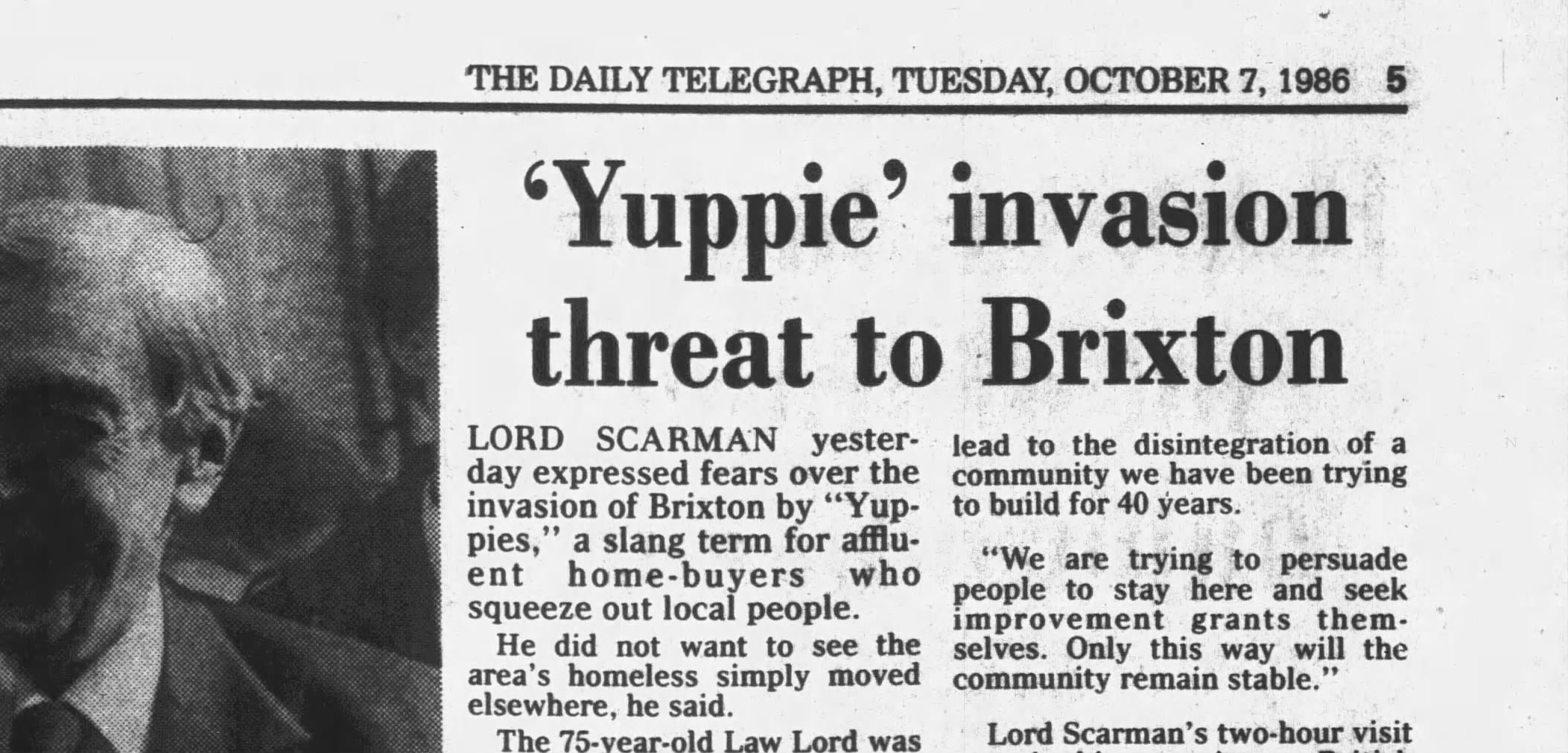
In 1986, we got louder rumblings about yuppies gentrifying previously working-class areas of London. Even Brixton in south London, which had seen riots in 1981 and 1985, was seeing a yuppie “invasion”. Lord Scarman, who had investigated the causes of the 1981 riot, expressed concern that residents were being pushed out. Well, as we know today, that process did not stop.