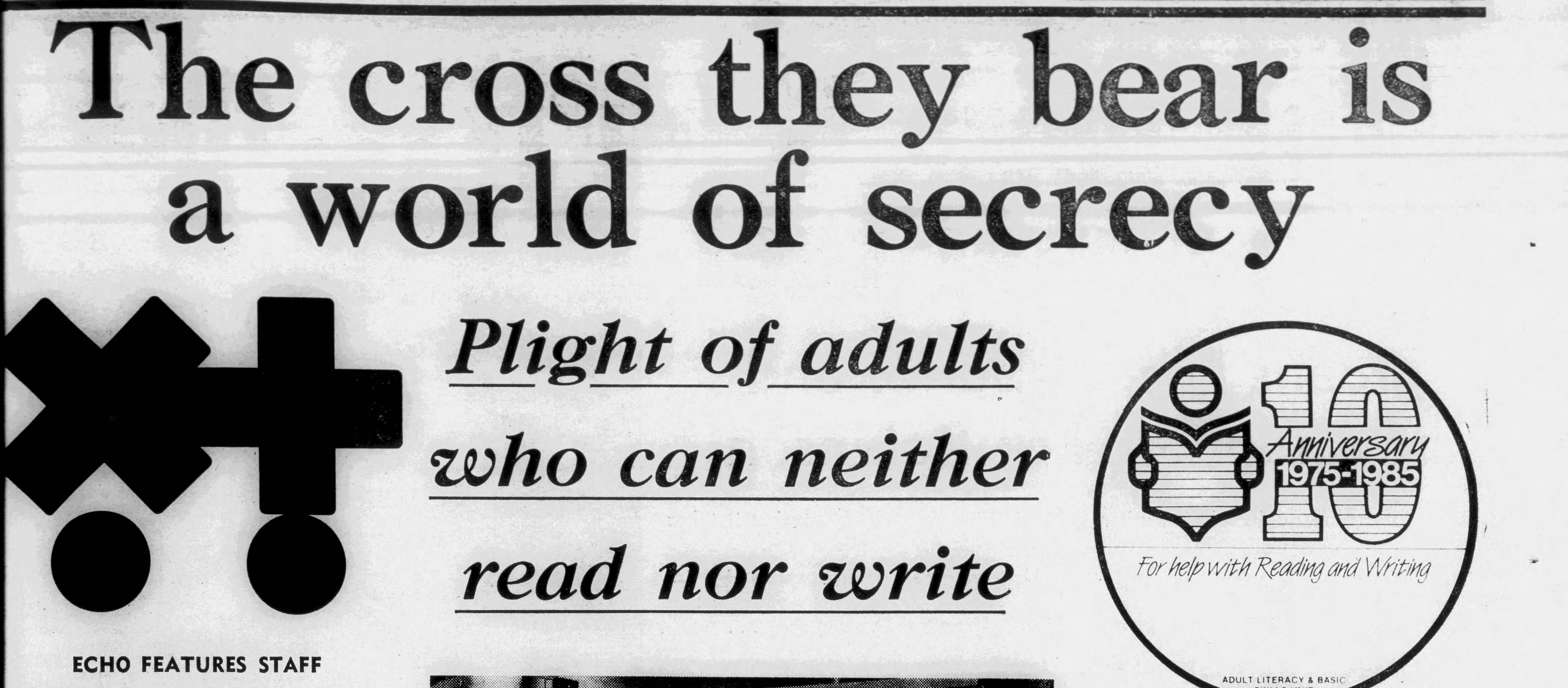
After I left university, I wanted to continue living in Liverpool – but unemployment was sky-high. So, I took a job teaching adult literacy in a community centre just off Scotland Road, in the predominantly Roman Catholic docks area. Helping illiterate adults read and write was a total eye opener on the effects that poverty and a lack of self esteem can have on people. It’s an experience that stayed with me to the present day.
It’s shocking to think but in 1986, about 5% of the UK population was illiterate. Among my students was a woman who had been a dinner lady at a school. I never asked her how she coped with not being able to read recipes or food instructions. But she couldn’t spell ‘the cat sat on the mat’. Using the same tools that teachers deployed when I was a five year old at infants school, I laid word cards out in front of her to say out loud. It was important never to demean or belittle but to approach the task like it was the most normal thing in the world.
But there were people who still put ‘X’ as their signature. When doing my Ancestry.com research about my own family, I discovered a handful of ancestors in the 19th century/early 20th century – normally farmers in northern Ireland – who put an X on birth, wedding, or death forms. Yet in the 1980s, this was still not unknown.
One of my pupils was a docker. Typical scouser with a bubbly wit and plenty to say. On our first encounter, he produced a finely written double sided sheet of paper – still recall the copperplate handwriting. His essay was titled ‘Justice and the Law’ arguing that capitalism enforces the law while the working class seeks justice. Scousers were very politicised and radical.
“Um,” I asked hesitantly, “you’re not actually illiterate are you?” He laughed and responded: “I just need the company, Tony.” He came to the literacy class not because he was unable to read or write, but as an older, sacked docker, he was staring into the void of long-term unemployment. Chatting to me was one way of alleviating the boredom.
Up until the 1970s, many people worked in jobs where they could just about get away with being illiterate. But better education and increasing white-collar employment meant those still unable to read or write could face mockery – and joblessness. In 1975, the BBC launched a sitcom with Bob Hoskins, On the Move, which encouraged adults to seek help. The storylines showed our protagonist gradually achieving literacy and this inspired about 70,000 Britons to enrol on courses like the one I was involved in.
I should give a name check to the organisation which ran these classes. The Vauxhall Neighbourhood Council was based in an old school building in what was then a very deprived area of the city. Mercifully it’s experienced some urban improvement since then. I used to get the bus from Liverpool city centre and get off on Scotland Road, which internally I called “landing on the moon”.
Because behind the shop fronts on the main road was a bleak landscape of waste ground, where 19th century terraced streets had been demolished, now punctuated by tower blocks with zero attempt at landscaping around them. Also punctuating the landscape were the sole survivors of those Victorian streets: the pubs. They were saved from the wrecking ball while everything around them was levelled. One such pub was the Trinity Vaults, which I believe is now apartments.
One of our contractual duties as tutors at the Vauxhall Neighbourhood Council was to sell its community paper, the Scottie Press, priced 5p, in the pubs. I think it’s still publishing and boasts that it’s the longest existing working-class community newspaper. Correct me if I’m wrong.
Today, literacy in the UK is at about 99%. Despite the constant refrain that education standards are tanking, more people in Britain than ever before can read and write. Whether what they’re reading and writing is any good – well, I leave that to you to decide.