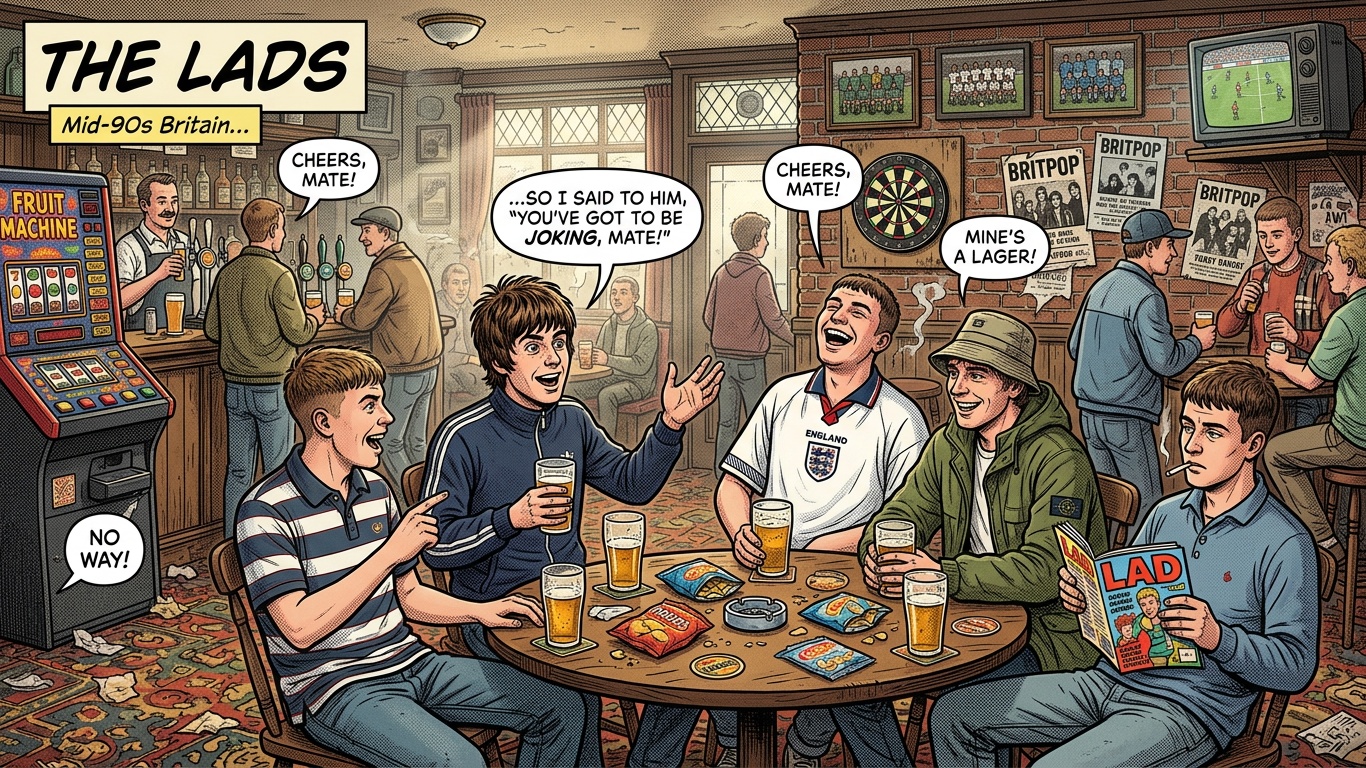
In the early 1990s, when Russell Brand was a teenager (born in 1975), a cultural movement spread across Britain that heroised the beer-swilling, foul-mouthed male, obsessed with footy, over the sensitive “new man” ideal promoted by feminism-friendly men in the 1980s. It was now OK again to revert to sexist banter because feminism had achieved most of its objectives (apparently) and men could stop bottling up their inherent sexism. The standard bearers for New Laddism, as it was termed, were young, trendy, and most of all, “ironic”. If you moaned that this was a cultural backsliding into misogyny, you were not in on the joke. I hated this cultural phenomenon at the time – as somebody who strived to be a new man in the 1980s – and I’m convinced it shaped the likes of Russell Brand.
SEE MY PREVIOUS COMMENTS: THE RISE AND FALL OF NEW LADDISM
This was a feature piece from The Independent newspaper in 1991 that summed up why New Laddism had exploded on to the scene:
“Sensitive, non-sexist, non-aggressive, and caring: the late Eighties New Man was barely credible as a role model for most men. Try as they might, they just couldn’t stomach re-inventing themselves so radically to suit women. And when they realised what they suspected all along – that women didn’t really fancy wimps anyway – there seemed little point.”
New Men, the article quipped, more than likely never existed in the 1980s. He was a fantasy dreamed up by Spare Rib – a prominent feminist magazine. “When the New Man pretended to be Germaine Greer’s soulmate, only journalists on The Guardian Women page believed him.” As the 1990s dawned, the New Man was derided as neurotic and emasculated. Now he was to be replaced by young males in their 20s who were “hedonistic, conservative, and pragmatic”. This was in sharp contrast to men in their 30s influenced by the 1960s and 1970s feminist movement. The New Man was essentially a child of Thatcher and Reagan, feeling no obligation to prove their commitment to fighting sexism and the patriarchy.
Not that they were bigoted. Oh no. They were not racist, “not too sexist”, and it seems that some of them were even gay. In fact on that point, I do remember a short-lived parallel development on the gay scene epitomised by the “gob” – gay yob. These were gay men who prided themselves on being “straight acting” and might even knock out a straight guy with a punch to the jaw if he was homophobic. But in reality, New Laddism was very heterosexual. Even to the point of mocking gay people on TV – but of course in an “ironic” way.
It was all about being “unambiguously” male. “He believes more in getting his end away than in women’s lib. But he’s no throwback: he sees women as sex objects but also as friends…” Reassuring? Not really. However, the advocates of New Laddism – whose names I’ll spare you but they included top comedians and cultural commentators of the early 1990s – argued that the New Lad was sophisticated, well-educated, who loved boozing and wasn’t going to join his girlfriend shopping on a Saturday afternoon but get down to the football terraces.
Even though New Laddism’s high priests claimed that they respected women, it was a fundamental political regression. Feminists were now objects of fun and the men who supported them, eunuchs. Misogyny spewed from the TV screen with a knowing wink and anybody complaining was a killjoy. There was even a reverence among some comedians who had emerged from the 1980s “alternative” scene – which had been notionally left-wing – for dinosaurs like the appalling Bernard Manning. All of this under the guise of being ironic, pro-working-class, and an old-fashioned Englishness.
Not that any of these misguided people, I hasten to add, would have endorsed Brand’s crimes. The point I’m making is that this disturbed person grew up with that ideology all around him. It could only legitimise his worst instincts.
So, how did New Lads convince themselves that this knuckle-dragging crap was the right way forward for society – including women. Well, they sought to enlist female support. The “ladette” was a woman who also enjoyed getting wrecked in the pubs and clubs, behaving outrageously, and even posing with little or no clothes on in lad mags. After years of feminists campaigning against women bearing their breasts in the tabloid newspapers, to boost sales, the ladette was held up as proof that feminists were a dreary bunch. Add to that the pathetic superficiality of “girl power”, and laddism had driven a truck loaded with beer kegs through thirty years of feminist activism.
Although Laddism petered out by the mid-90s, it left a legacy. Twenty years before, in 1975, the actor Oliver Reed had been doused with water on the Johnny Carson show when fellow actor Shelley Winters took exception to his deliberately provocative sexist comments about women belonging in the kitchen.

By 1991, an extremely inebriated Reed turned up on Channel 4’s After Dark chat show to humiliate veteran feminist Kate Millett by kissing her live on air. Was that the end of Reed appearing on TV? Far from it. He became something of a cult favourite, even if treated like a buffoon, among the New Lads. Sad in that it not only heroised dreadful male behaviour but let his sad clowning eclipse his undoubted acting ability.
In the early 2000s, Russell Brand came on to our screens as the skinny-jeaned shaman from Essex. The comparison to Rasputin was obvious, especially the way he bewitched liberal media types into believing he possessed a unique insight into how Britain’s youth were thinking. Always amazed how the Hampstead set are suckers for a cockney snake oil salesman. And I say that as somebody who grew up in Essex and knows a shyster when I see one.
To me, he was an odious bi-product of 1990s Laddism. Not to say that all those who cheerleaded Laddism in the 90s were sex pests, or worse, but individuals like Brand were able to legitimise, or make light, appalling behaviour towards women by using comic turns of phrase. In Brand’s case, that even extended to jokes about rape that would have been unthinkable in the New Man era of the 1980s. Certainly on the alternative circuit.
What Brand’s decline and fall should teach a generation of men who came to maturity (or not) during the Laddist era is that feminism still has a way to go. Some men, as Brand illustrated, still can’t get their heads round the concept of consent before and during sex. Or that women really are equal human beings. Feminism still has a great deal of work to do.